Contents
Decoding Your Moisturizer
The Science Behind Healthy, Hydrated Skin
Moisturizing seems simple, but if you have ever picked up a bottle and wondered what all those long chemical names mean, you are not alone.
A great moisturizer does more than just make your skin feel wet; it maintains skin health, treats dryness, and improves your skin’s overall appearance.
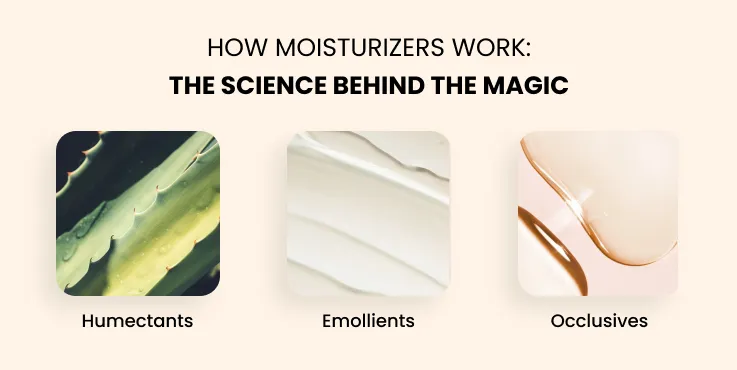
To choose the right product, it helps to understand the “Big Three” ingredients that power most commercial formulas.
The Big Three:
How Moisturizers Actually Work
Most over-the-counter moisturizers blend two or more of these core ingredient classes, balancing them depending on your skin type.
1. Humectants (The Magnets)
Ingredients like Glycerin, Hyaluronic Acid, and Aloe Vera draw water from the environment and your skin’s deeper layers up to the surface.
Note: While great for an instant plump, using them in ultra-high concentrations long-term can actually backfire and cause dryness if not paired with a barrier.
2. Emollients (The Smoothers)
Ingredients like Plant Oils (Jojoba, Almond), Shea Butter, and Ceramides fill in the microscopic gaps between skin cells.
They make your skin feel incredibly soft and smooth, though they aren’t enough on their own for severely dry conditions.
3. Occlusive Agents (The Shields)
Ingredients like Petroleum Jelly, Paraffin, and Mineral Oil create a physical barrier on top of the skin to lock moisture in.
Because they are heavy, they can sometimes trigger acne or folliculitis if used on the wrong skin types.
Heavy-Symptom Relief vs. Long-Term Repair
When dealing with dry skin, the type of formulation you choose dictates whether you are just fixing a temporary symptom or truly repairing your skin.
Paraffin Moisturizers (Symptom Relief)
Derived from petroleum, these formulas act as heavy occlusive shields and emollients.
They are fantastic for providing immediate, comforting relief to severe skin conditions like Eczema, Psoriasis, and extreme xerosis.
However, because they can clog pores, they aren’t ideal for your face or acne-prone skin.
Ceramide Moisturizers (True Barrier Repair)
Ceramides are lipids naturally present in healthy skin that get depleted when your skin dries out.
Unlike traditional moisturizers that stop working the moment the temporary dryness goes away, ceramides offer long-term utility.
They actively rebuild your skin barrier, making it resilient enough to handle environmental pollution, while delivering excellent anti-aging benefits like smoothing fine lines.
Finding Your Perfect Fit
Your skincare routine should change based on your age, skin thickness, and dryness levels.
Freyza offers three scientifically-backed, premium formulations tailored for different clinical needs.
Hydrapiel Intense Cream
For Thick Skin & Severe Dryness
Look for a heavy-hitting combination like:
- Urea 15%
- Lactic Acid 5%
- Glycolic Acid 5%
- Petrolatum
- Glycerin
…to intensely soften and hydrate tough, flaky areas.
Hydrapiel Lotion
For Overall Skin Health & Barrier Repair
A lightweight yet effective blend of:
- Ceramide 0.6%
- Sodium Hyaluronate 0.6%
- Glycerin 2%
- Vitamin E
…helps restore your daily defense system.
Mahsa Barrier Repair Cream
For Daily Facial Care & Sensitive Skin
Opt for a non-comedogenic cream featuring:
- Ceramide 1%
- Mango Seed Butter 1%
- Sodium Hyaluronate
This deeply repairs the delicate facial barrier without clogging your pores, keeping wrinkles and irritation at bay.